



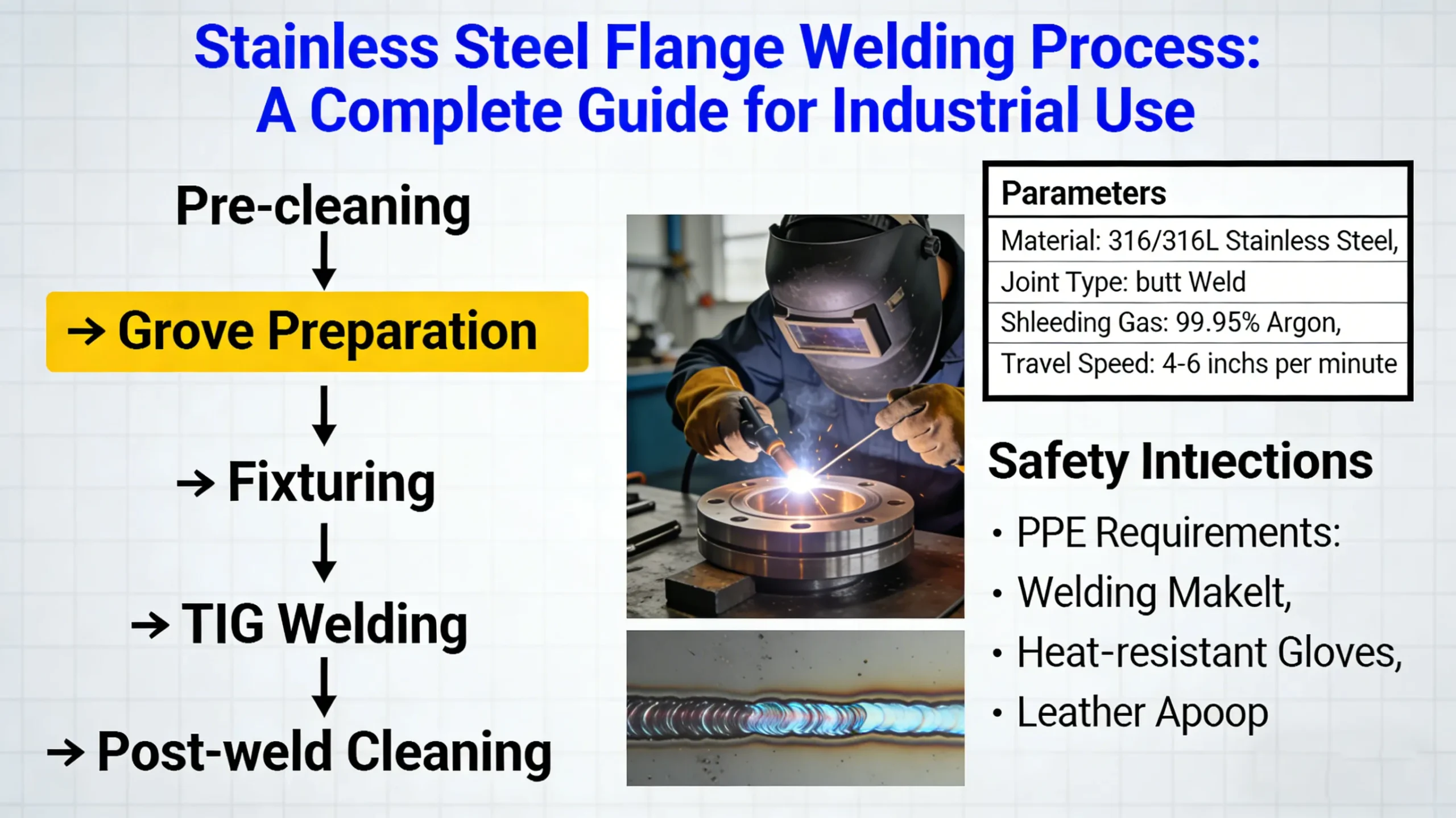
Stainless Steel Flange Welding Process: A Complete Guide for Industrial Use
Welding is a critical step in stainless steel flange installation, directly impacting piping system integrity, corrosion resistance, and long-term performance—especially for grades like 316 and 316L. Proper execution avoids common issues such as sensitization, porosity, or weak joints. This guide breaks down the stainless steel flange welding process into actionable steps. Learn key techniques, prep tips, and grade-specific considerations to ensure successful welds.
1. Pre-Welding Preparation: Lay the Foundation
Preparation is non-negotiable for high-quality welds. First, clean flange surfaces (sealing face, weld bevel) using a stainless steel wire brush or acetone to remove oil, rust, or debris—contaminants cause porosity and weaken bonds. Next, check fit-up: ensure flanges align perfectly (gap ≤2mm) to avoid uneven welds. For 316L (low-carbon), skip pre-heating (unlike carbon steel) to prevent sensitization. Use only stainless steel-specific tools (clamps, electrodes) to avoid cross-contamination.
2. Core Welding Techniques for Stainless Steel Flanges
The most common method is GTAW (TIG) welding, ideal for its precision. Use ER316L filler metal for 316/316L flanges—matching alloy content preserves corrosion resistance. Maintain a short arc length (2-3mm) and low heat input (80-120A) to minimize heat-affected zones (HAZ). For pipe-flange joints, weld in small, overlapping passes (2-3mm each) and cool between passes with dry air (avoid water quenching). Shield the weld pool with argon gas (flow rate 15-20 l/min) to prevent oxidation.
3. Post-Welding Treatment: Ensure Durability
Post-weld steps prevent corrosion and validate quality. Grind weld beads smoothly to match flange contours—sharp edges trap moisture. For 316L, passivation (treating with nitric acid) restores the protective oxide layer. Inspect welds via visual checks (no cracks/porosity) or non-destructive testing (NDT) like dye penetrant for critical applications (oil/gas, chemical processing). Avoid post-weld heat treatment for 316/316L, as it risks sensitization.
4. Grade-Specific Considerations: 316 vs 316L
Key difference: 316 (0.08% max carbon) is prone to sensitization if overheated, so strictly control heat input. 316L (0.03% max carbon) resists sensitization, making it better for welded systems in corrosive environments (marine, chemical plants). Always use filler metal matching the base material to maintain performance.

 English
 简体中文
 العربية